
The furnace is running again, the hockey registration fee just cleared, and three credit card statements are sitting on the kitchen counter with three different due dates. You'll get to them after bedtime.
When you do, these tips for paying off credit card debt work on any budget: list every balance and rate, pick one payoff method and stick with it, move high-interest balances to a lower rate, free up a little cash each month, and lean on free help when you want a second set of eyes.
You're in good company. Americans carried $1.26 trillion in credit card balances in the second quarter of 2026, according to the Federal Reserve Bank of New York. With the average rate on credit card accounts charged interest at 22.15% that same quarter, per the Federal Reserve, a big share of every payment can go to interest instead of the balance.
These five tips work with the budget you have today, whether you owe $2,000 or $20,000. None of them ask you to cancel every weekend up north, either.
Strategy 1: Start With a Complete Debt Inventory
A debt inventory is one list of everything you owe. It comes first because you can't choose the right payoff strategy until you can see the whole picture.
Pull up each account and write down four things for every debt:
- The current balance
- The interest rate (APR)
- The minimum payment
- The due date
Add car loans and medical bills too. Seeing it all in one place can sting for a minute. Then it turns into something you can work on, instead of a pile of envelopes you avoid opening.
Then track spending for one week, from the gas station coffee to the weekly grocery haul to the Saturday soccer snacks. That week shows where extra dollars might come from in Strategy 4, and our budgeting calculators can help you sort it out.
Strategy 2: Choose A Payoff Method and Commit
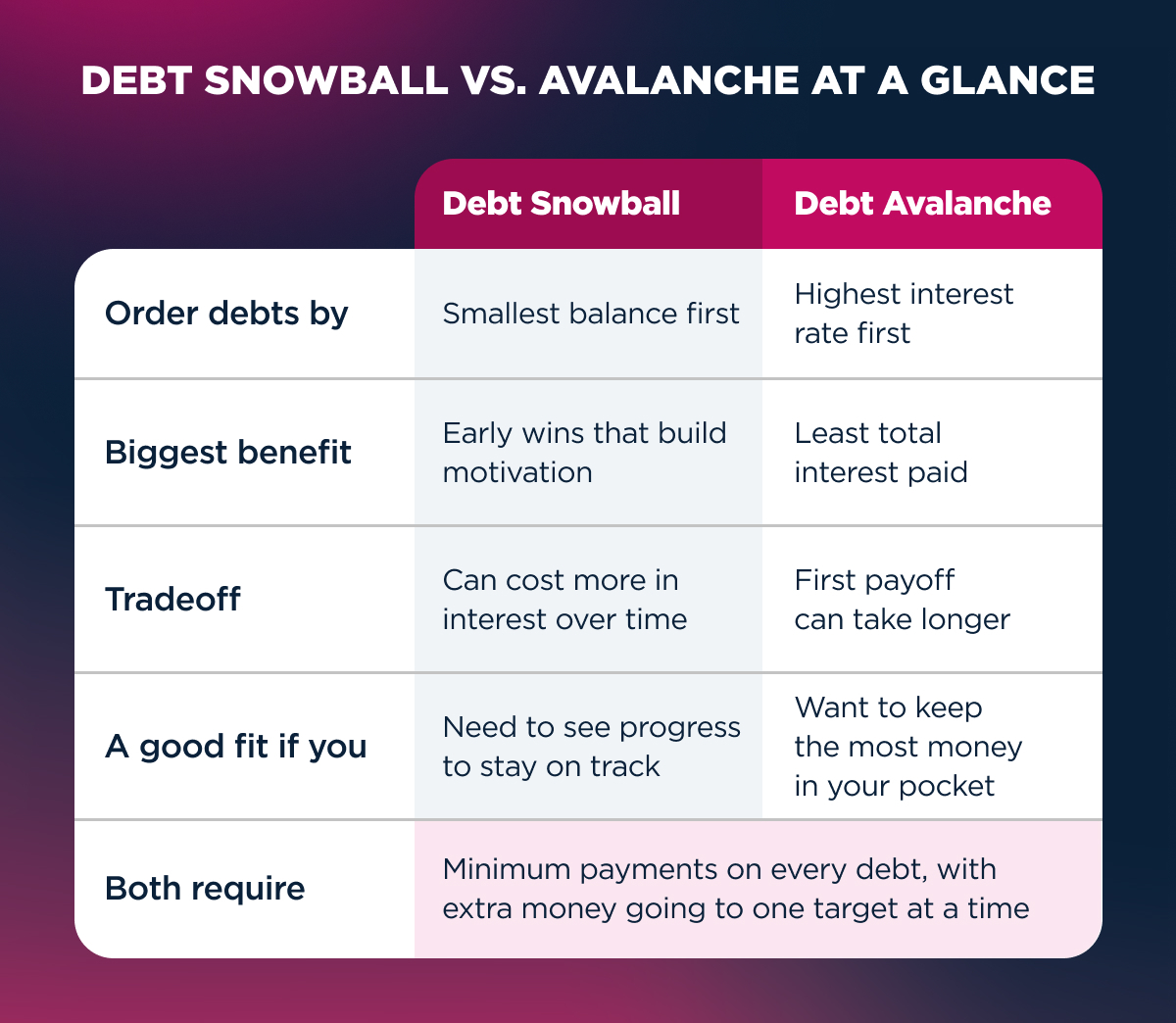
The two most popular ways to pay off debt are the debt snowball (smallest balance first) and the debt avalanche (highest interest rate first). Both work. The better one is the one you'll keep doing.
Either way, pay the minimum on every debt, put every extra dollar toward one target, and when it's paid off, roll that payment into the next one.
THE DEBT SNOWBALL METHOD
Minnesotans already know how a snowball works: start small, keep it rolling, and it grows. List your debts from the smallest balance to the largest. Paying off that small store card first feels a lot like getting the snowblower tuned up before the first storm. One less thing hanging over you, and a little momentum for the next one. Researchers at Northwestern University's Kellogg School of Management found that people who focused on closing out individual balances were more likely to eliminate their debt entirely (Journal of Marketing Research, 2012).
THE DEBT AVALANCHE METHOD
List your debts from the highest interest rate to the lowest. Because the most expensive debt goes first, you pay less interest overall and often finish sooner. The tradeoff is patience: if your highest-rate card also carries your biggest balance, that first payoff can take a while.
Still deciding? Pick one and start this month. You can switch later, and starting matters more than choosing perfectly.
See your payoff date. Enter your balance, rate, and monthly payment to see how long payoff will take, and how much sooner you could finish by adding $25 or $50 a month.

Strategy 3: Consolidate High-interest Debt
Consolidating debt means moving several high-interest balances into one lower-rate payment, so more of each dollar goes to the balance instead of interest. The two most common tools are a balance transfer credit card and a debt consolidation loan.
BALANCE TRANSFER CREDIT CARD
A balance transfer moves what you owe on one card to a card with a lower rate. Many cards charge a fee on the amount you move, so read the terms before you transfer. If a card offers a 0% introductory rate, note exactly when that period ends and what the rate becomes after.
At City & County Credit Union, our Platinum Credit Card has rates as low as 11.50% APR, free balance transfers, and no annual fee. Our guide to balance transfers walks through it step by step.
DEBT CONSOLIDATION LOAN
A debt consolidation loan pays off your cards and replaces them with one fixed monthly payment and a set end date. Knowing the exact month you'll be done is its own kind of relief. Because CCCU is member-owned and not-for-profit, earnings go back to members through competitive rates and lower fees. Check today's personal loan rates.
One caution: once your cards are paid off, consider keeping them open (it can help your credit utilization) but out of your wallet. Running the balances back up is how consolidation backfires.

Strategy 4: Find Monthly Cash Flow You Didn't Know You Had
Small, repeatable changes usually free up more money for debt than one dramatic cut. Start with the costs that renew without you noticing:
- Cancel subscriptions and memberships nobody in the house uses anymore
- Call your internet, phone, and insurance providers and ask about a lower rate
- Plan one more dinner at home each week (hotdish counts)
- Wait 24 hours before any non-essential purchase
- Sell what the kids have outgrown, like last season's skates, the youth hockey pads, or the bike with training wheels
If you want a simple framework, the 50/30/20 approach splits take-home pay into 50% for needs, 30% for wants, and 20% for savings and debt payments. If 20% isn't realistic yet, start at 10% and build from there.
AUTOMATE THE EXTRA
Set an automatic transfer toward your target debt for the day after payday. The extra money goes to work before it gets spent, and there's nothing to remember.
Strategy 5: Get Free Financial Help Through CCCU
You don't have to figure this out alone. CCCU members get no-cost counseling and tools that make a payoff plan easier to build and easier to keep.
FINANCIAL COUNSELING WITH GREENPATH
Through our partnership with GreenPath Financial Wellness, a nonprofit, CCCU members have access to free financial counseling. A counselor looks at your full picture and helps you map out a realistic budget and payoff plan. Mention your City & County Credit Union membership when you reach out.
CREDIT SCORE MONITORING WITH SAVVYMONEY
SavvyMoney gives you your credit score, full credit report, and credit monitoring, and checking it won't affect your score. Watching that number climb as your balances drop is one of the best parts of paying off debt. Your score is available in the CCCU mobile app or online banking.
A CONVERSATION WITH OUR TEAM
Prefer to sit down with someone local? Book a branch appointment and we'll walk through your options side by side, from a balance transfer to a consolidation loan, at a pace that works for you.
CCCU Tools That Help You Pay Off Debt Faster

City & County Credit Union has been helping Minnesota and western Wisconsin families take control of their money since 1928.
We're member-owned and not-for-profit, serving 62,000+ members across 15 Minnesota and Wisconsin counties.
These tools can put your plan to work:
- Platinum Credit Card: low rates, free balance transfers, and no annual fee
- Debt Consolidation Loan: one fixed monthly payment with a set payoff date
- Life Happens Loan: a lower-rate option for big life expenses like vet bills, orthodontics, or a wedding, so they don't end up on a credit card
- Balance Transfer Calculator: see what moving a balance could save you
Pick one tip and start it this week. Maybe tonight, after the kids are asleep and the counter is finally clear. When you're ready to compare options, we're right here.