
Your credit score walks into the dealership before you do. It’s the first thing lenders check when they’re figuring out what rate to offer — and it can shape your monthly payment more than the price of the car itself.
Here's what your score actually means for your rate, and what to do if yours isn't quite where you'd like it yet.
What Your Credit Score Actually Means for Your Rate
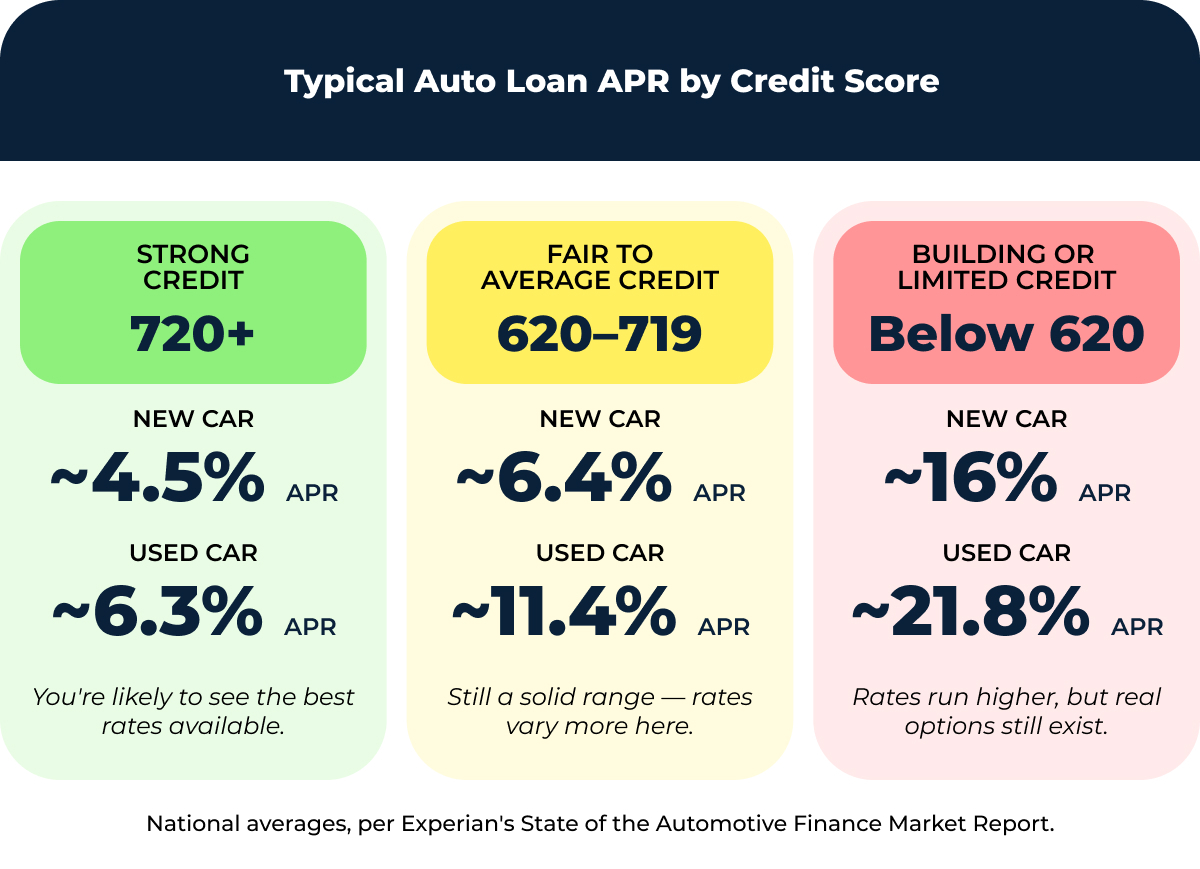
There's no single score every lender requires. But generally, the higher your score, the lower the rate you're likely to qualify for. Here's roughly what that looks like nationally, according to Experian's State of the Automotive Finance Market report:
| Your Credit Standing | Typical Score Range | Avg. New Car APR | Avg. Used Car APR |
| Strong credit | 720+ | ~4.5% | ~6.3% |
| Fair to average credit | 620–719 | ~6.4% | ~11.4% |
| Building or limited credit | Below 620 | ~16% | ~21.8% |
These are national averages, not CCCU's own rates, and your score is just one piece of the picture. Check your rate before you shop, so you know your real number going in instead of finding out at the dealership.
Buying your first car with no credit history?
That's common, and it won't automatically rule you out. Lenders can still look at your income and your down payment, or whether you've got a co-signer lined up.
What Else Shapes Your Rate
A few things beyond your score shape what you're actually offered:
- A bigger down payment lowers what you're financing in the first place
- A shorter loan term usually costs less in total interest, even if the monthly payment runs higher
- A newer car with fewer miles reads as less risk to a lender than an older one
- Your income and existing monthly debt matter too, since a lender wants the payment to fit what you're already paying each month
Score sets the range. Everything above moves you inside it.
What to Do If Your Score Isn't Where You Want It
 Score-building really comes down to two things: paying on time, and keeping your balances low relative to your limits. Length of credit history and how many new accounts you've opened matter too, just less. None of it happens overnight, but it's worth knowing before you shop.
Check Your Credit Report for Errors First
Errors happen: a late payment that isn't actually yours, an account you never opened. Pull your free credit report and dispute anything that doesn't look right before you apply, not after.
Save for a Down Payment
Putting money down lowers what you're financing, which can strengthen your application and may improve your rate, especially if your score is still building.
Consider a Co-Signer if Your Score Needs Support
A co-signer with strong credit shares responsibility for the loan, which gives a lender more confidence saying yes. It's a real option if your score is still building, especially for a first car with no history behind it yet.
Give It Time Before You Shop
Credit doesn't move on a fixed schedule, but consistent on-time payments can start to show up in a few months. If you can wait even a little before you need the car, that time is worth using.
How Hard Inquiries Work When You're Rate Shopping
Every application creates a hard inquiry, and each one can knock your score down a few points. That's nothing to stress over if you're not applying often.
The Consumer Financial Protection Bureau notes that multiple auto loan inquiries made within 14 to 45 days of each other generally count as a single inquiry. Compare a few lenders in that window and it reads as smart shopping, which is exactly the move that gets you a real number before you're standing in a finance office.
 Compare Financing Before the Dealership, Not After
That's the number worth having going in. Dealership financing can be convenient, but it's built to work in the dealer's favor more than yours. Knowing your rate first means you're comparing real numbers, not just taking whatever's offered.
Checking your rate first gives you something to compare against whatever the dealership offers, before you've fallen in love with a car and lost your leverage to walk away.
Check Your Rate Before You Shop
At City & County Credit Union, we finance up to 100% of your vehicle's value, and new loans come with no payment due for 90 days. As a member-owned credit union, our rates are built around our members, not a sales target.
See what your rate could look like, or run the numbers on a specific vehicle with our calculator.